Lunar Flight Environment Demonstrator

LFED

Solo-built VTOL testbed to simulate lunar flight dynamics.

A central two-axis gimbaled jet offsets about five-sixths of Earth's gravity and counters atmospheric drag. A separate outer platform supplies the remaining lunar-equivalent thrust and attitude control.

The goal is to let real guidance, navigation, control, and sensing hardware fly the kinds of attitude / thrust combinations a lander would experience during lunar terminal descent.

Current: integrated vehicle assembled; turbine ground testing complete; flight software / HIL integration ongoing.
Next up: tethered closed-loop attitude control.
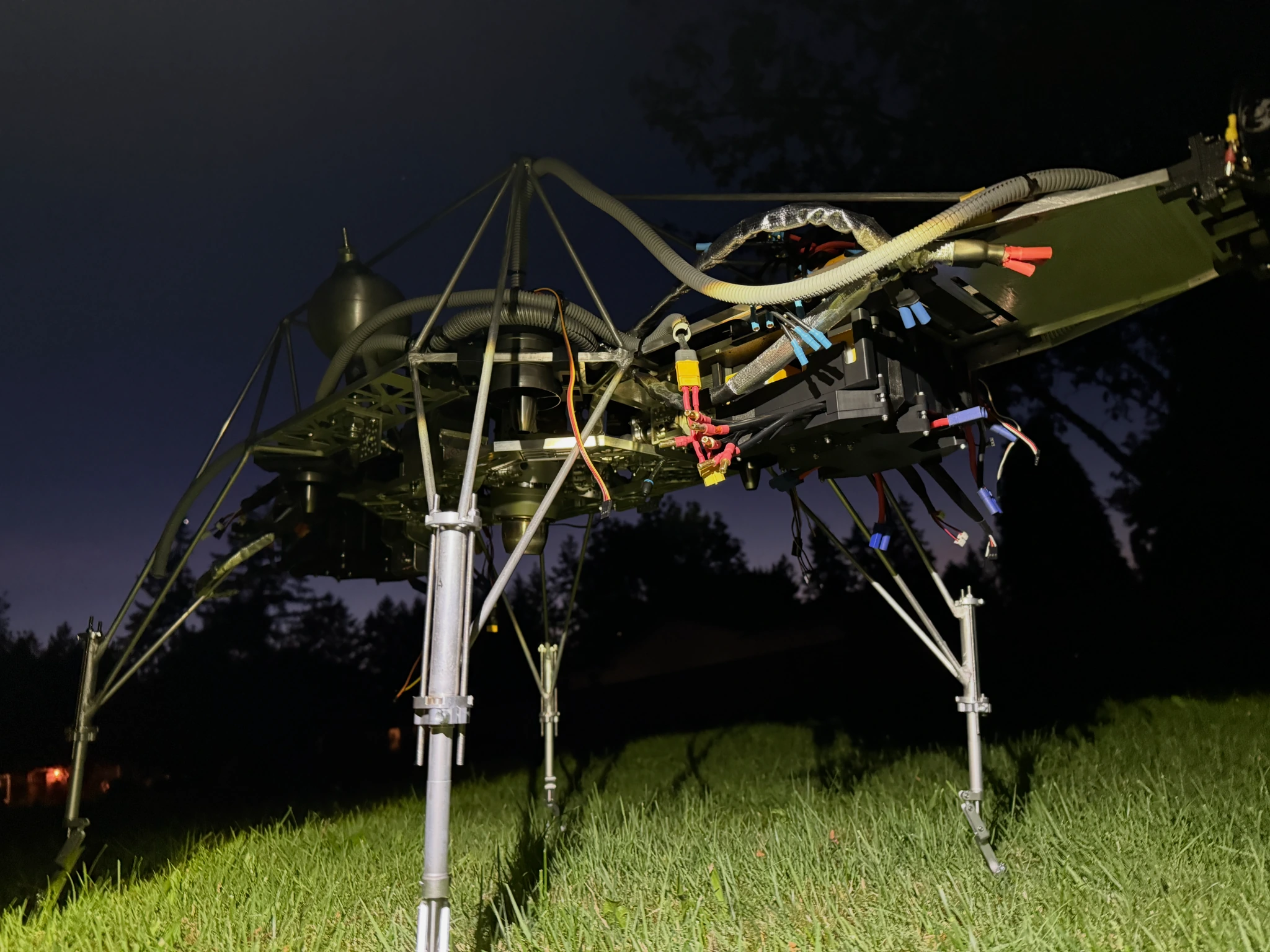
LFED vehicle at night, showing the gimbaled propulsion system and outer structure

Build video

LFED Build Montage Video

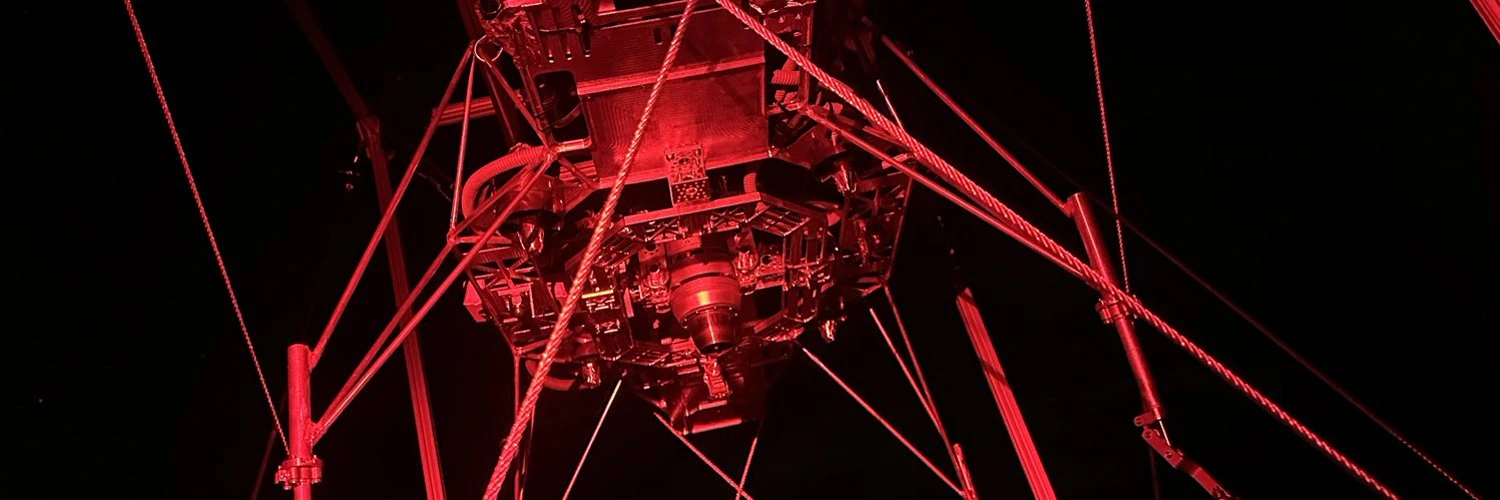
LFED restrained in a red-lit ground test
3-minute build montage

Why I built it

I wanted a real flying testbed for experimenting with lunar-landing GNC — and building it became the hands-on engineering challenge I was missing.

I had already been fascinated by lunar landers, Apollo, and the LLRV for years. I wanted a vehicle I could use to learn and experiment with guidance, navigation, and control while reproducing some of the flight dynamics that make lunar landing different from flying an ordinary drone or rocket on Earth.

Building that testbed also became the kind of hands-on engineering work I wasn't getting from mostly online coursework. It stopped being a side project a long time ago.

~40 lb vehicle2-axis gimbaled turbine~5/6 gravity-offset targetfour-EDF outer platformdual-layer runtime assurance

How the lunar simulation works

Separate the gravity-offset system from the vehicle being tested.

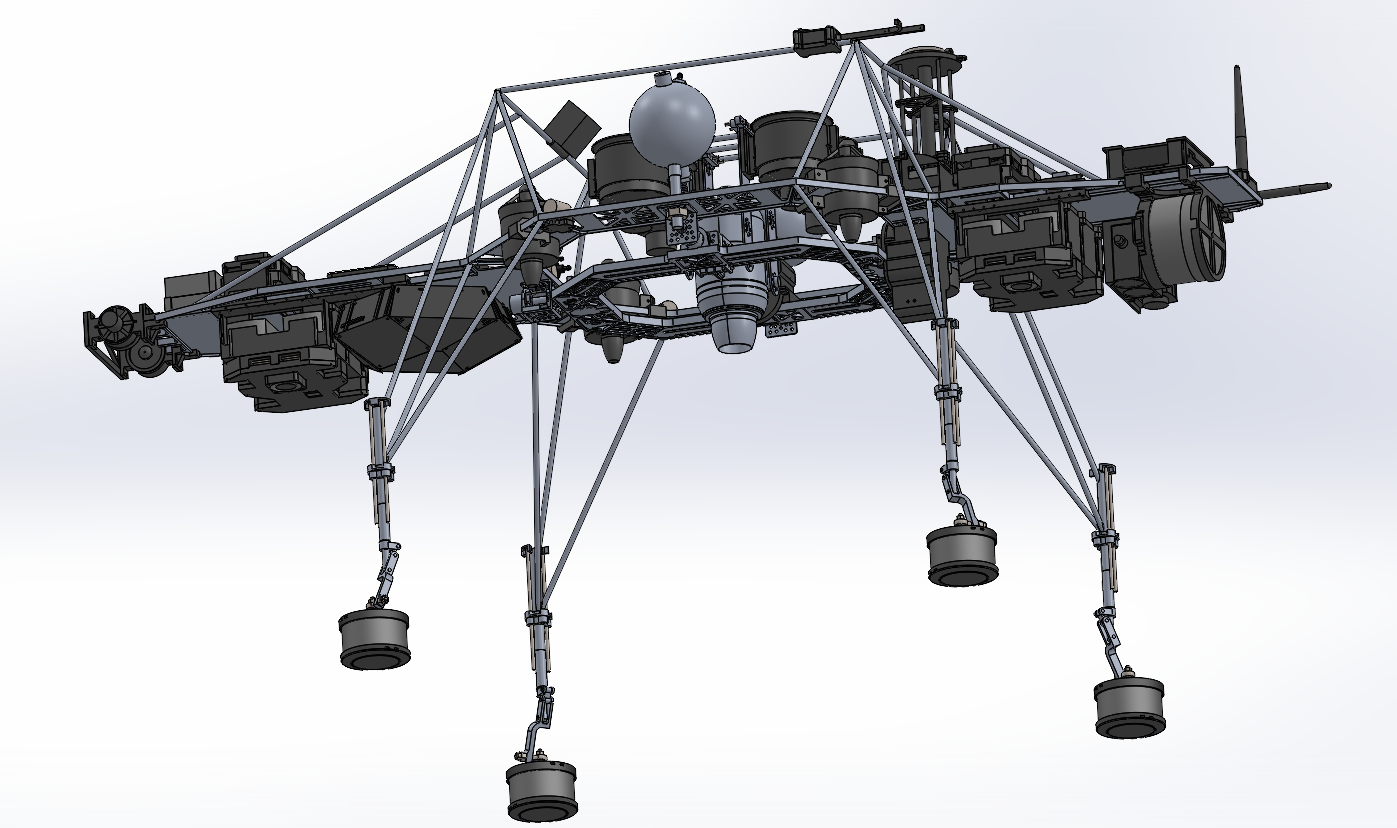
CAD model of LFED showing the central offset system, outer platform, and landing gear
Representative CAD view of the vehicle configuration.

The central offset system uses a jet engine in a two-axis gimbal near the vehicle center of mass. Its job is to carry roughly five-sixths of the vehicle's Earth weight and counter atmospheric drag without dictating the outer platform's attitude.

The outer platform then behaves more like the lunar vehicle: four EDFs provide the remaining thrust and attitude-control authority in the residual one-sixth-g environment.

Because the two systems are controlled separately, the outer platform can tilt without simply pointing the gravity-offset thrust vector the same way. That is what lets LFED target the lunar relationship between attitude, thrust, and translational acceleration rather than merely trace a lunar-looking path through Earth gravity.

ScopeFlight-dynamics / GNC testbed for automated and operator-in-the-loop lunar landing research. It complements ground simulation, HIL, and conventional flight test rather than replacing them.
Offset systemGimbaled turbine carries most of Earth weight and counters drag.
Outer platformFour EDFs supply residual thrust and attitude-control authority.
Independent controlThe outer platform can follow lunar-style attitude / thrust histories.

Why the dynamics matter

A terrestrial rocket or drone can reproduce a descent trajectory while using a different attitude / thrust history to get there. During late diverts and hazard avoidance, that difference can change control margins, sensor pointing, maneuver time, and which landing sites remain reachable.

Same path is not the same maneuver.LFED is aimed at testing the integrated system in the latter.

Selected build + test work

Getting subsystem test data before the vehicle flies.

Original test artifacts, plain captions, and enough explanation to show what was being learned.

Aerodynamic EDF characterization

I built a load-cell test rig and drove it along open stretches of beach to measure EDF thrust versus airspeed and angle of attack, while also logging ESC temperature, current, and battery voltage. One main question was how the EDFs behave in the retro-propulsive orientation they will see during descent.

Rig + live test telemetry shown at left.
Turbine + integrated ground testing

The vehicle is restrained in a dedicated test stand for turbine runs and closed-loop ground work. Thermal imaging is used to measure heating at frame locations where sensitive hardware may eventually be mounted.

Integrated static setup + turbine-test thermal view.

Actuators, integration, calibration

Commanded-versus-measured servo angle and current are logged under load before the mechanism goes onto the vehicle. A lot of the rest is less glamorous: wiring, fit checks, calibration, debugging, and trying to make all the subsystems agree about what “zero” means.

Servo / gimbal stress test + integration work.

Flight software / test architecture

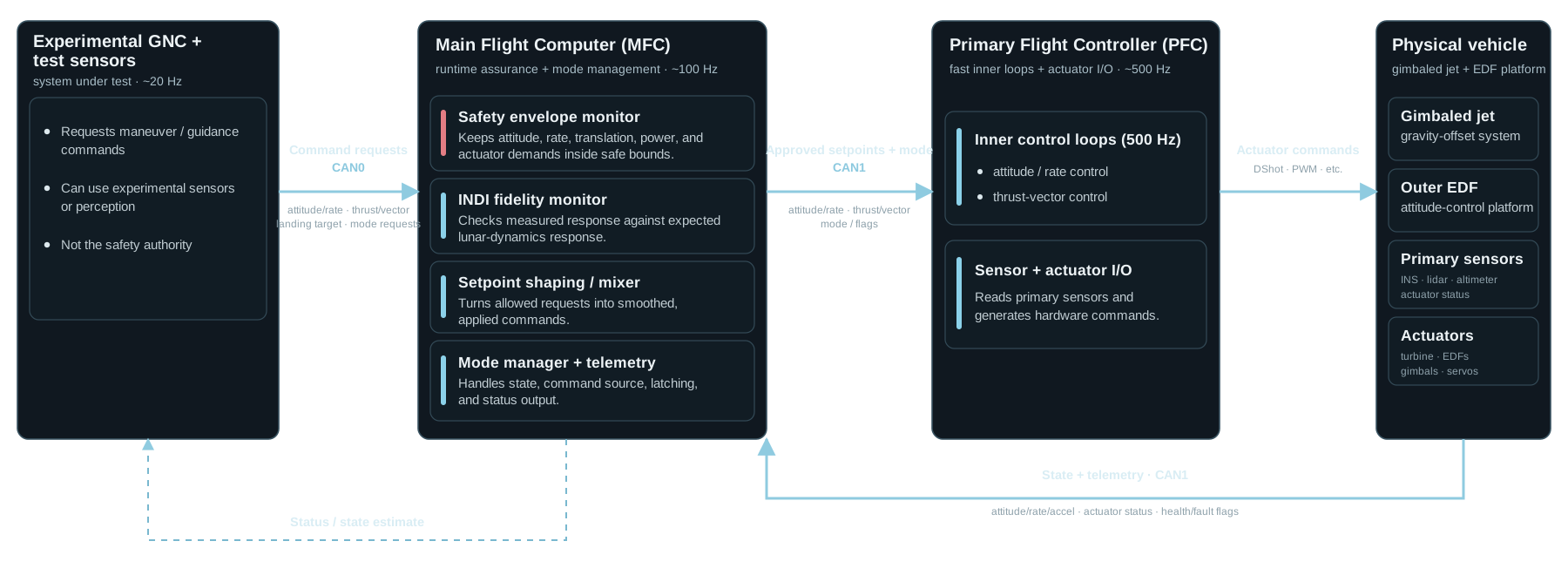
Let the experimental GNC “sit in the driver's seat” without making it the safety authority.

The experimental system can request real maneuvers. The Main Flight Computer supervises those requests with a dual-layer runtime-assurance architecture, while the Primary Flight Controller owns the fast inner loops and actuator I/O.

LFED flight software architecture diagram

Current state

Integrated vehicle assembled. Turbine ground tests, EDF characterization, actuator tests, and substantial HIL / flight-software integration completed or underway.

About the builder

Why this project exists

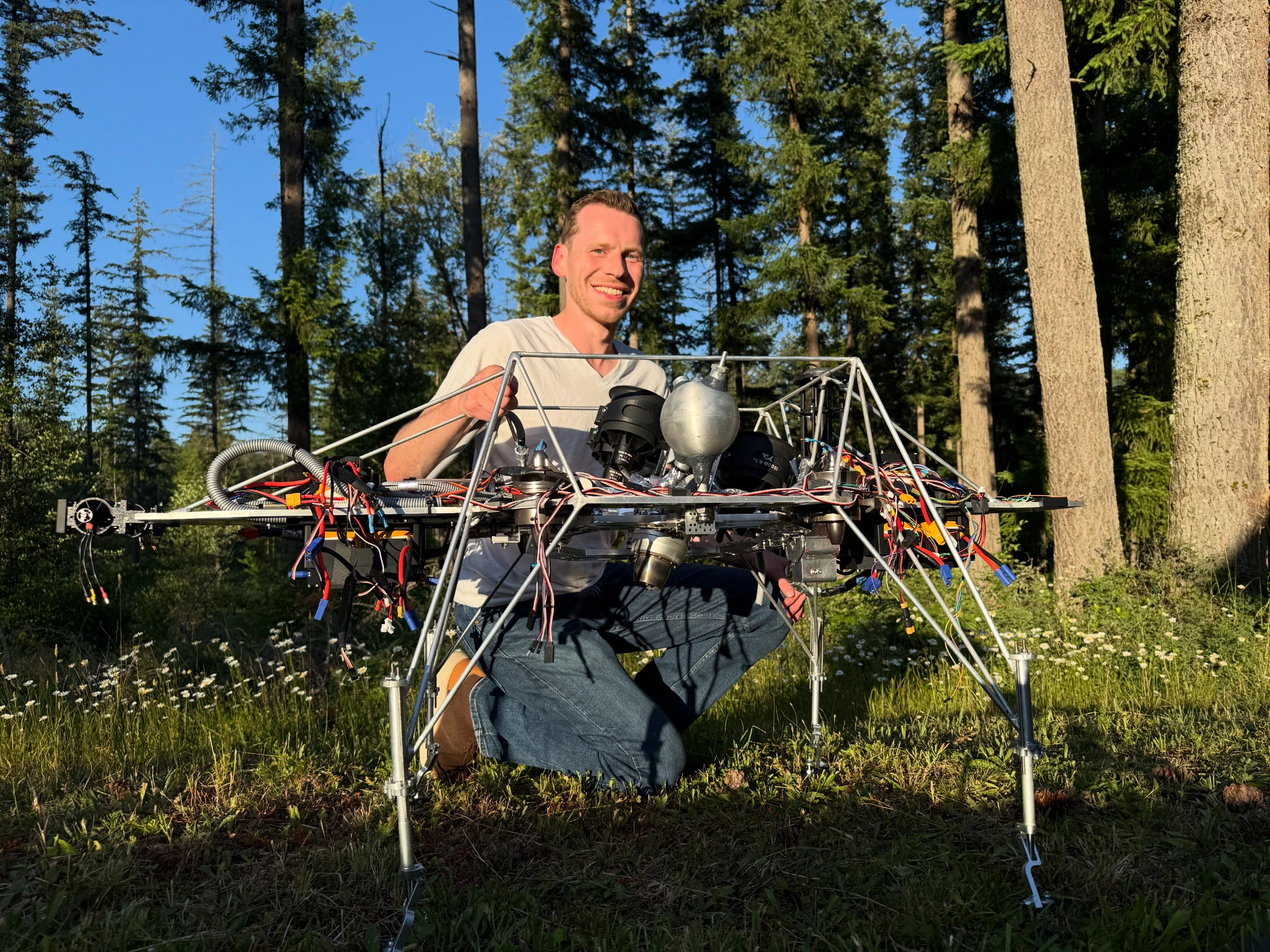
Steven Schierman kneeling beside LFED

I wanted a real flying testbed for learning and experimenting with lunar-landing GNC. Building it became the hands-on engineering challenge I was missing.

I previously worked as an integration technician on early Starship test articles, then went back to finish a computer science degree and continue engineering coursework. Seasonal work led me into wildland-fire helicopter operations, where I still work today.

The goal of returning to spaceflight never went away. I had been fascinated by Apollo and the LLRV for years, and wanted a vehicle where I could experiment with guidance, navigation, and control while reproducing some of the flight dynamics that make lunar landing different from ordinary Earth flight.

Building that testbed also gave me the kind of hands-on, multidisciplinary engineering work I wasn't getting from mostly online coursework. It stopped being a side project a long time ago. V1 is still a proof of concept; if it earns a second version, the next vehicle would be built much more deliberately as a robust research platform for external GNC systems.